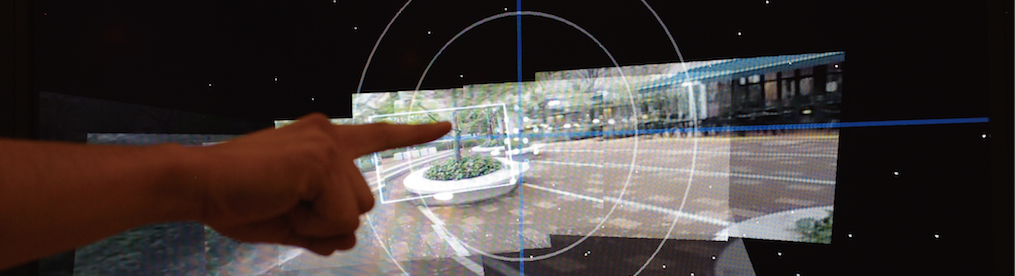

3D displays aid in spatial awareness and enhance immersion in content. In particular, autostereoscopic displays have been gaining attention for convenience as they do not require other equipment. However, autostereoscopic displays face significant challenges, such as limited viewing angles and viewing zones. To address these, we propose HoloArm, a face-following autostereoscopic display that moves to always be in front of the user. HoloArm dynamically adjusts the autostereoscopic display according to the user’s face orientation, achieving a wide viewing angle and a free viewing zone without needing devices like glasses or a headset. HoloArm is a window into the virtual world, offering users a deep sense of immersion as if peering into another world. In this paper, we implemented HoloArm prototype and conducted a system evaluation and a user study. The results of the use study showed HoloArm improves the user’s sense of presence compared to an autostereoscopic display.
3Dディスプレイは空間認識を助け、コンテンツへの没入感を高めます。特に、自動立体視ディスプレイは、他の機器を必要としない利便性から注目を集めています。
しかし、自動立体視ディスプレイは、視野角や視域に制限があるなどの大きな課題を抱えています。
そこで我々は、常にユーザの正面に来るように動く顔追従型自動立体視ディスプレイHoloArmを提案する。HoloArmは、ユーザーの顔の向きに応じて自動立体視ディスプレイを動的に調整し、メガネやヘッドセットのような装置を必要とせずに、広い視野角と自由な視聴ゾーンを実現します。HoloArmは仮想世界への窓であり、ユーザーに別世界を覗き込むような深い没入感を提供します。
本論文では、HoloArmのプロトタイプを実装し、システム評価とユーザ調査を行いました。その結果、HoloArmは自動立体視ディスプレイと比較して、ユーザの臨場感を向上させることがわかりました。
References
- Koya Dendo, Yuta Itoh, Émilie Fabre, Jun Rekimoto, HoloArm: A Face-Following 3D Display Using Autostereoscopic Display and Robot Arm Proceedings of IEEE VR Workshops, Workshop 19: 1st Workshop on Seamless Reality: AR Technologies for Seamless Perception and Cognition between Cyber and Physical Spaces, pp 581—583, 2024 (DOI: 10.1109/VRW62533.2024.00111)
- Koya Dendo, Yuta Itoh, Émilie Fabre, and Jun Rekimoto. 2025. HoloArm: A Face-Following 3D Display Using Autostereoscopic Display and Robot Arm. In Proceedings of the Extended Abstracts of the CHI Conference on Human Factors in Computing Systems (CHI EA ’25). Association for Computing Machinery, New York, NY, USA, Article 732, 1–4. https://doi.org/10.1145/3706599.3721115
 Rekimoto Lab