
Figure

Overview of the Pinch Tactile Display. The fabric changes its tactile sensation by manipulating the electrostatic force between the conductive fabric and the user’s finger. Users interact with it by wearing gloves and rubbing them together. The texture variation is achieved by adjusting the voltage and frequency, with the voltage modulated by the power supply and the frequency controlled by Arduino. The inherent thinness and softness of the fabric allows for a natural touch experience, enhancing immersive interactions in virtual reality environments.
Abstract
Haptic displays play an important role in enhancing the sense of presence in VR and telepresence. Displaying the tactile properties of fabrics has potential in the fashion industry, but there are difficulties in dynamically displaying different types of tactile sensations while maintaining their flexible properties. The vibrotactile stimulation of fabrics is an important element in the tactile properties of fabrics, as it greatly affects the way a garment feels when rubbed against the skin. To dynamically change the vibrotactile stimuli, many studies have used mechanical actuators. However, when combined with fabric, the soft properties of the fabric are compromised by the stiffness of the actuator. In addition, because the vibration generated by such actuators is applied to a single point, it is not possible to provide a uniform tactile sensation over the entire surface of the fabric, resulting in an uneven tactile sensation. In this study, we propose a Pinching Tactile Display: a conductive cloth that changes the tactile sensation by controlling electrostatic adsorption. By controlling the voltage and frequency applied to the conductive cloth, different tactile sensations can be dynamically generated. This makes it possible to create a tactile device in which tactile sensations are applied to the entire fabric while maintaining the thin and soft characteristics of the fabric. As a result, users could experiment with tactile sensations by picking up and rubbing the fabric in the same way they normally touch it. This mechanism has the potential for dynamic tactile transformation of soft materials.
preprint
Pinching Tactile Display: End-to-End Vibration Transmission of Fabric Roughness via Electrostatic Adsorption
Figures
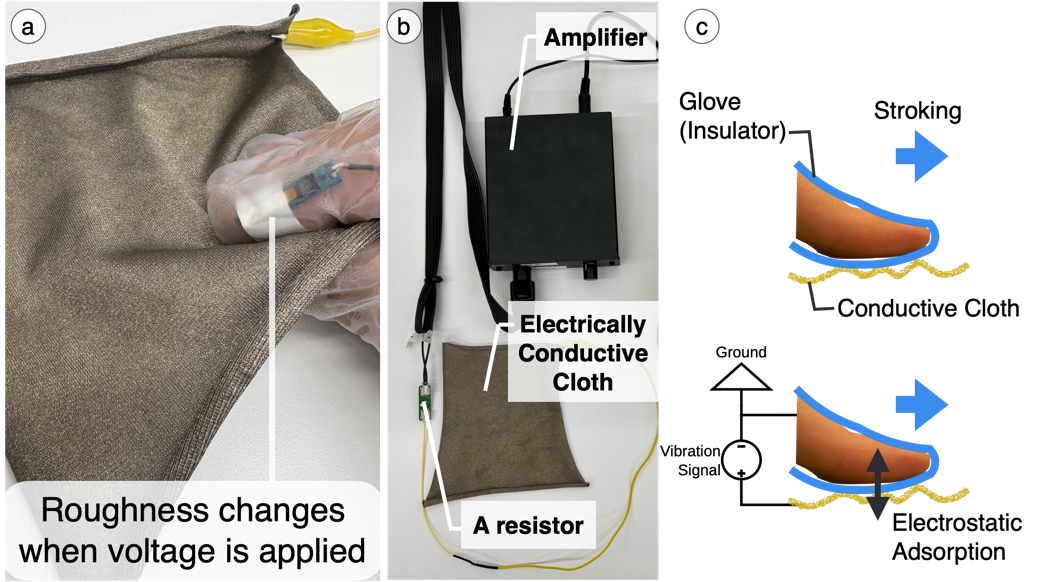
(a) Overview of the display concept: tactile sensation is modulated by manipulating electrostatic adsorption between the conductive fabric and the user’s finger, enabling texture variations (primarily perceived roughness) during fabric exploration gestures. (b) System configuration for end-to-end vibration transmission: the input vibration signal is amplified and applied to the conductive cloth, enabling presentation of vibration signals recorded from fabric. (c) Principle of the Pinching Tactile Display: the applied high voltage attracts and controls small electric currents flowing within the finger, so that users perceive the fabric’s tactile sensation as if it has changed.
Abstract
Transmitting fabric tactile sensation is difficult because of fabric’s complex properties: softness, delicacy, and a relatively uniform surface texture. We propose Pinching Tactile Display (PTD), a conductive fabric system that enables end-to-end transmission of vibration signals measured from fabric. In a user study, we found that perceived roughness can be modulated within 2.1–3.0 on a Likert scale (suggestively comparable to fine-textile differences), and that this modulation arises from voltage-driven bumpiness and frequency-driven stickiness, with largely additive effects. We also found a clear correlation between input vibration signals and finger vibrations, demonstrating that input vibrations are reliably transmitted to the user’s finger. These results validate the system as a viable approach for end-to-end fabric tactile transmission and point to potential applications such as remote fabric exploration, VR, and fashion e-commerce.

