
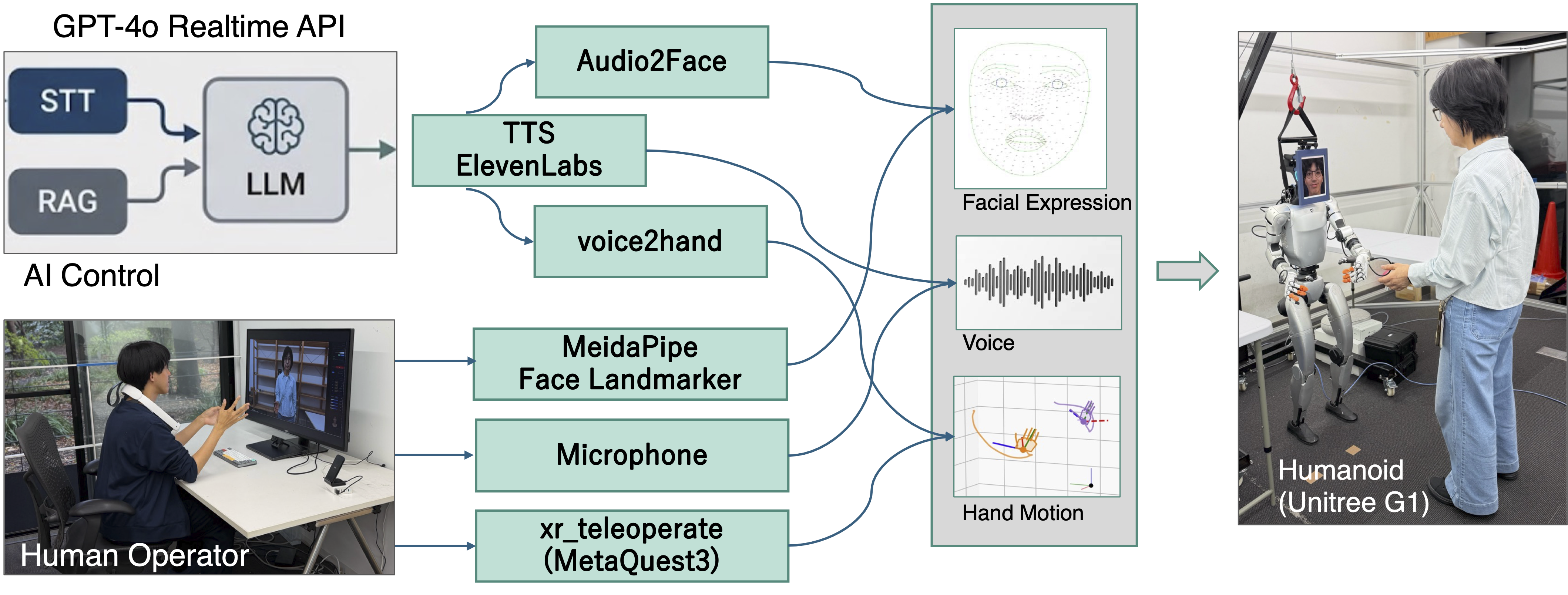
Can people distinguish between human and AI agency in humanoid teleoperation? To explore this question, we developed Ghost-in-the-Loop, a teleoperation framework that supports both human-operated and AI-generated control of a robot’s voice, facial expressions, and gestures while maintaining a consistent embodiment. We conducted a preliminary online study (N=50) in which participants viewed short interaction clips generated by either a Human Operator or an AI Control and judged the perceived source of control. Results suggest that participants often struggled to distinguish between the two conditions in brief interactions. Qualitative responses indicate that judgments were primarily influenced by perceived naturalness, temporal coordination, and consistency across speech, facial expression, and gesture. These findings provide initial insights into agency perception in embodied human–AI communication and motivate future investigations of blended human–AI telepresence systems.
人は、ヒューマノイドの遠隔操作において、動作の主体が人間かAIかを識別できるのだろうか。この問いを検討するため、ロボットの身体性を一貫して保ちながら、音声・表情・ジェスチャを人間による操作とAIによる生成の双方で制御できる遠隔操作フレームワーク Ghost-in-the-Loop を開発した。予備的なオンライン実験(N=50)では、人間またはAIがロボットを制御する短いインタラクション映像を参加者に提示し、制御の主体がどちらであると感じたかを回答してもらった。その結果、短時間のインタラクションでは、参加者が両条件の識別に困難を示す場合が多いことが示唆された。自由記述回答の分析から、判断は主に、知覚された自然さ、時間的な協調、および発話・表情・ジェスチャ間の一貫性に左右されることが示された。本研究は、身体性を伴う人間–AIコミュニケーションにおける行為主体の知覚について初期的な知見を提供し、人間とAIによる制御を融合したテレプレゼンスシステムの今後の研究に向けた示唆を与える。
References:

