
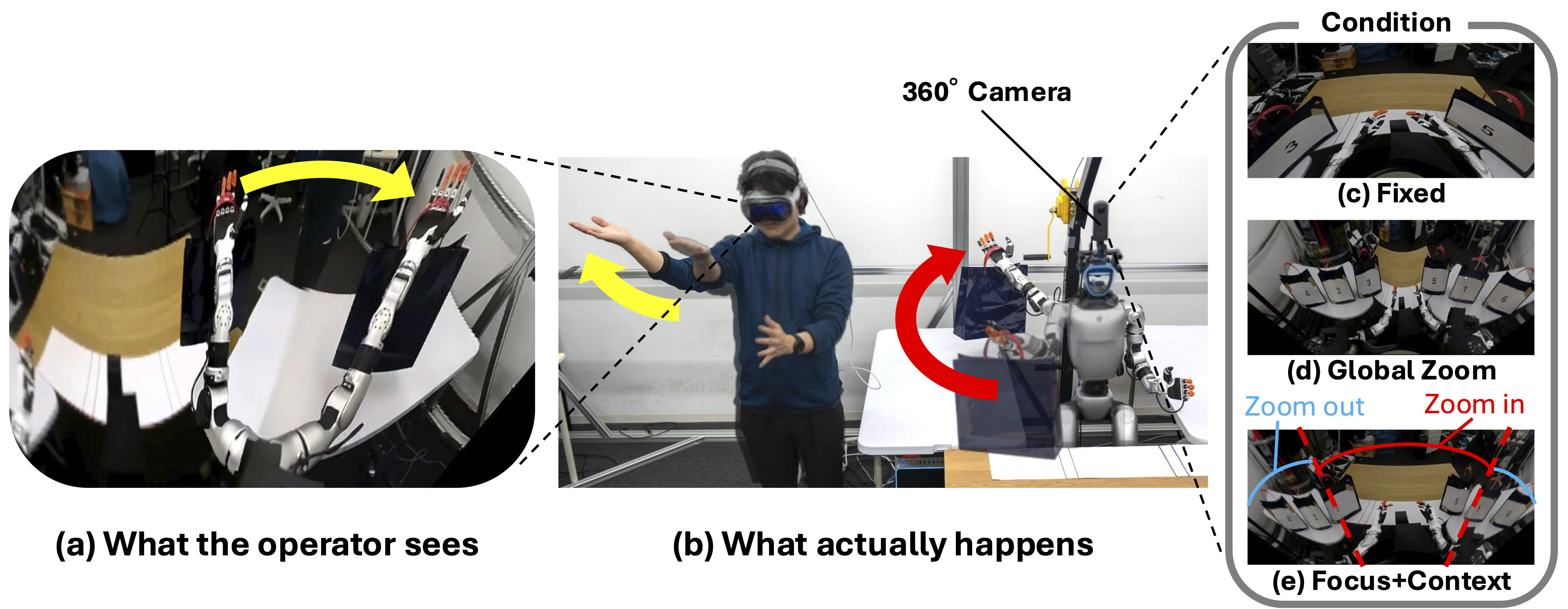
Traditional first-person humanoid teleoperation uses a one-to-one mapping between the operator’s and robot’s viewpoints and movements, requiring the operator to rotate to access side and rear targets. We present RealityRemapping, a coupled visual–motor remapping technique that pairs a panoramic azimuth warp with its inverse upper-limb yaw transform. Our working prototype implements two mappings: Global Zoom (GZ) and Focus+Context (F+C). In a within-subject study (N = 8; 72 trials), GZ yielded the highest number of completed trials (23/24; Fixed: 20/24; F+C: 21/24), whereas F+C was preferred by six of the eight participants. Thus, task completion and subjective preference favored different mappings in this sample.
従来の一人称視点によるヒューマノイドの遠隔操作では、ロボットの視界と操作系を一対一で人間の操作空間にマップするため、側方や後方の対象へのアクセスに操作者自身の回転を要した。本研究では、パノラマ映像の方位角変換と、その逆変換に基づく上肢のヨー角変換を組み合わせ、現実とのマッピングを変容・拡張する視覚–運動連動リマッピング(Reality Remapping)を提案する。動作可能なプロトタイプに、Global Zoom(GZ)とFocus+Context(F+C)の2方式を実装した。参加者内実験(N=8、計72試行)では、GZで課題完了数が最も多かった(GZ:23/24、固定条件:20/24、F+C:21/24)。一方、参加者8名中6名がF+Cを好んだ。したがって、本実験のサンプルでは、課題完了数と主観的な好みで優位となるリマッピング方式が異なった。
Refence

